How long does it take to learn to surf? The short answer is, it takes a lifetime. But a coach can help make the journey a little more direct and intentional.
But if you’re starting from ground zero with proper instruction, consistent practice, and a focus on fundamentals, a complete beginner can become a reasonably independent beginner surfer within a dedicated season of putting the water time in.
But there’s an important distinction between standing up on a surfboard and actually learning how to surf.
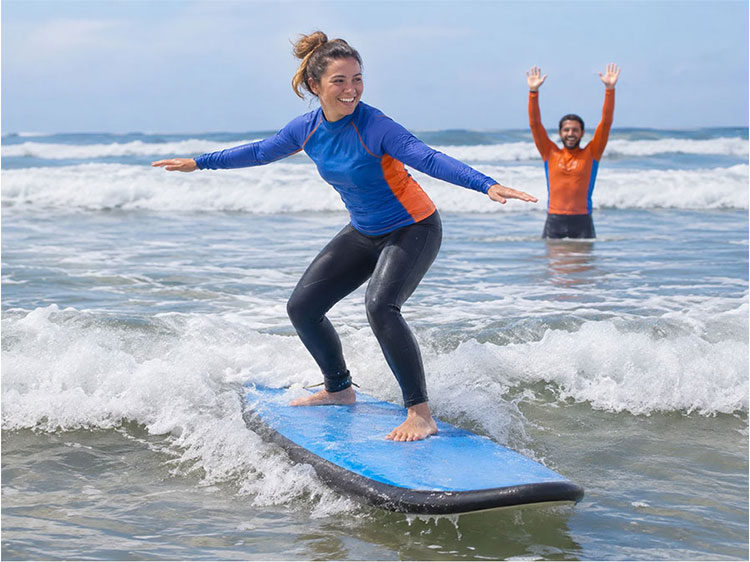
VS.
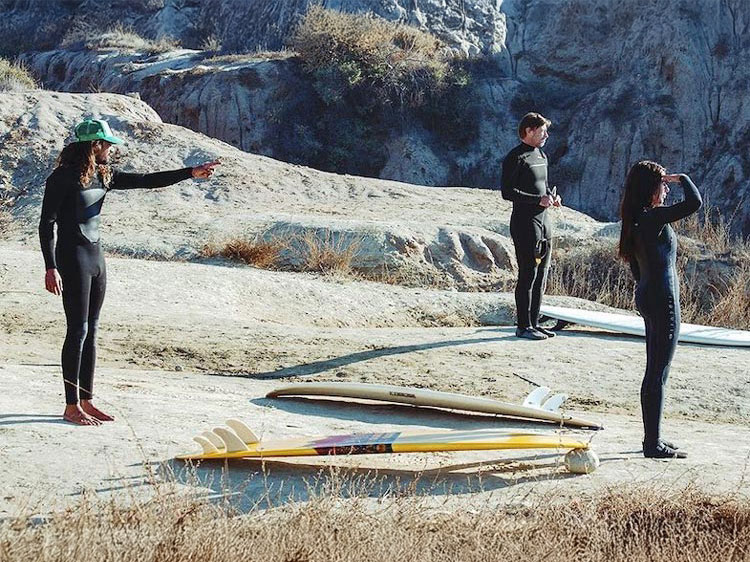
A good coach starts educating before you paddle out together.
They might identify line-up positioning, the best approach to paddling out, and characteristics of a particular surf spot.
In the water they would not grow weary in holding you accountable to good paddling technique. They would talk out loud and discuss with you what they are reading in waves as they arrive. They would insist on intentional decision making and question your movements in order to keep you on task and targeting the right goals.
After more than 15 years of coaching, we’ve found that the speed of your progress depends less on how many surf lessons you take and more on what you do between them.
Let’s look at what realistic progression looks like, why some beginners improve faster than others, and how to develop the skills necessary to surf independently.
How Many Surf Lessons Does It Take to Learn to Surf?
There’s no fixed number of surf lessons required to learn how to surf. The quality of instruction and the amount of purposeful practice between lessons matter far more than the number of lessons themselves.
However, there are some general milestones we see students work through.
Your First Surf Lesson: Learning Fundamentals
During your first surf lesson, the goal should be to establish comfort and control on your surfboard.
Depending on the student, we might focus on entering and exiting the water safely, finding balance in the paddling position while holding good form, sitting on the board, changing direction, and developing other fundamental board control skills.
Some students begin catching waves during their first session. Others benefit from spending more time becoming familiar with their equipment.
The objective isn’t to stand up on your first wave. It’s to leave with a better understanding of how to control your surfboard with good technique and what you should practice next.
After 3-5 Sessions: Combining Skills and Catching Waves
With several lessons and consistent independent practice, students should start combining their fundamental skills in small, beginner friendly waves.
They’re learning to turn their board and transition into paddling efficiently without adjustment, identify suitable waves, position themselves correctly, and catch waves without relying on someone to push them.
At this stage, progress is less about how many waves they ride and more about the quality of the process they can perform in a smooth and seamless fashion
After One Month: Building Consistency and Confidence
After several weeks of purposeful practice, students may become noticeably more comfortable handling their equipment and navigating familiar conditions.
Movements that initially required considerable thought begin feeling more fluent. Their paddling becomes more efficient, their positioning more deliberate, and their understanding of why they catch or miss waves improves.
Of course, someone practicing several times per week will have a very different experience from someone who only enters the water during coached sessions.
After Three Months: Becoming a Confident Independent Surfer
With quality instruction and consistent practice, we’ve seen complete beginners develop the ability to surf independently in as little as three months, sometimes considerably faster.
By independence, we mean being able to paddle out, navigate suitable beginner conditions, recognize and position for appropriate waves, and catch and ride them without assistance.
That doesn’t mean they’re ready for challenging waves or jockeying for waves in crowded, high-performance lineups.
These timelines aren’t guarantees. Every student progresses differently depending on physical ability, comfort in the ocean, access to suitable conditions, and willingness to practice.
But becoming an independent beginner doesn’t necessarily need to take years.
What Progress in Surfing Actually Looks Like
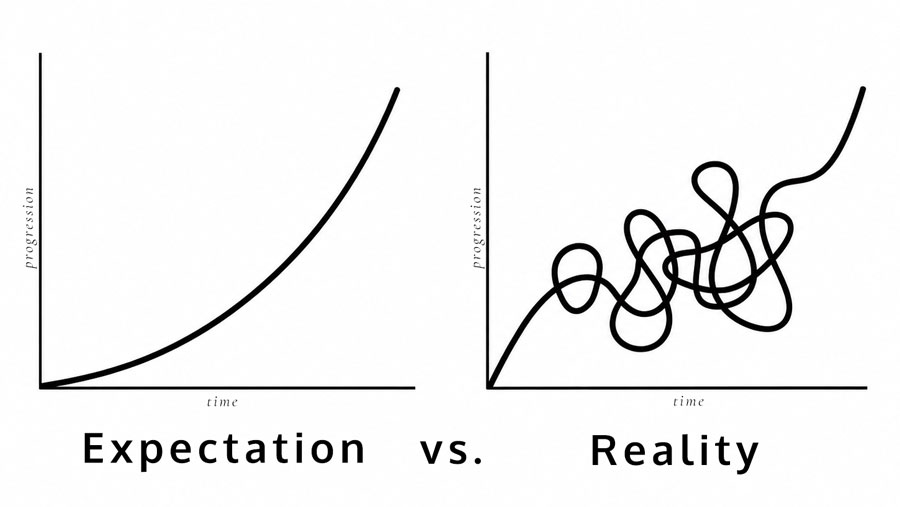
Most beginners measure their progress by how many waves they catch or how long they can stand on their surfboard.
We see things differently.
In fact, we’d argue that the real skill in surfing is not in riding waves, but how well you’re able to catch them.
When you develop these skills, catching waves becomes less about strenuous paddling and more about positioning yourself in the right place at the right time.
Rather than working to catch a wave, your goal should be to understand how to position yourself so that the wave catches you.
That’s a key pillar of our coaching philosophy.
A surfer who understands positioning and timing can often catch waves with considerably less effort than someone relying on strength and willpower alone.
That’s genuine progress, even if it doesn’t immediately translate into more waves ridden.
Why Complete Beginners Can Progress Faster Than Experienced Surfers
One of the things we enjoy most about coaching complete beginners is that they arrive with a clean mental slate.
They haven’t spent any time reinforcing inefficient techniques or developing misconceptions about how surfing works. They’re often more receptive to fundamental exercises that experienced surfers might find boring or beneath them.
We’ve coached complete beginners who initially struggled just to balance while lying on their surfboards or could barely sit upright without feeling unstable.
Many of those became noticeably more comfortable within a single hour.
Their paddling becomes less awkward. They sit on their boards with greater stability. Their shoulders relax, their bodies become less tense, and they stop clinging to their surfboards as though they’re hanging onto a log in the middle of the ocean.
These might seem like small improvements, but they’re significant and offer a lot of inspiration to continue learning.
When we work with surfers who have developed inefficient techniques, we frequently need to revisit these fundamentals.
That can be frustrating for someone who believes they’ve already mastered them and that belief can prevent them from improving even when the skill is re-addressed.
But often times taking a step back is exactly what allows someone to make a significant leap forward if the student is open and receptive to it.
Why We Don’t Push Students Into Waves
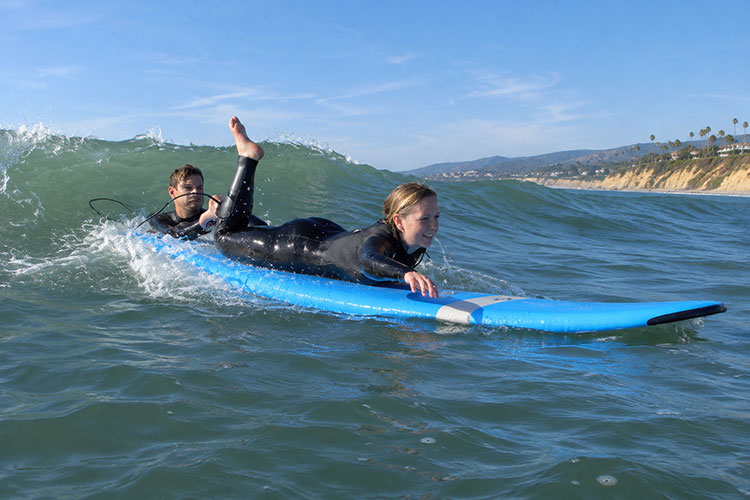
Many conventional surf lessons involve an instructor positioning a student and pushing their surfboard into a wave.
The student gets an exciting ride and walks away feeling like they’ve learned to surf.
But what have they actually learned?
If someone else handled the positioning and wave catching, the student hasn’t necessarily developed either of those abilities.
There’s nothing inherently wrong with this experience. For someone on vacation who wants to try surfing once, being pushed into waves is a thrill unlike anything else.
But for someone who genuinely wants to learn how to surf, it can create a misleading sense of progress.
The problem becomes obvious when the student eventually enters the water without an instructor.
Suddenly, they’re unable to catch the waves they were previously riding.
Our approach is to teach students how to catch waves themselves from the beginning, rather than creating a dependency on the instructor.
And that means accepting something many people may find initially frustrating.
They’re going to miss waves. A lot of them.
Missing Waves Is Part of Learning to Surf
One of the biggest misconceptions about surfing is that missing a wave represents failure.
We see it as a necessary part of the learning process, and even as experience coaches we often deliberately miss waves to serve a greater purpose.
In fact, one of our foundational philosophies is called The Art of Missing Waves, which we’ve developed into a free educational e-book.
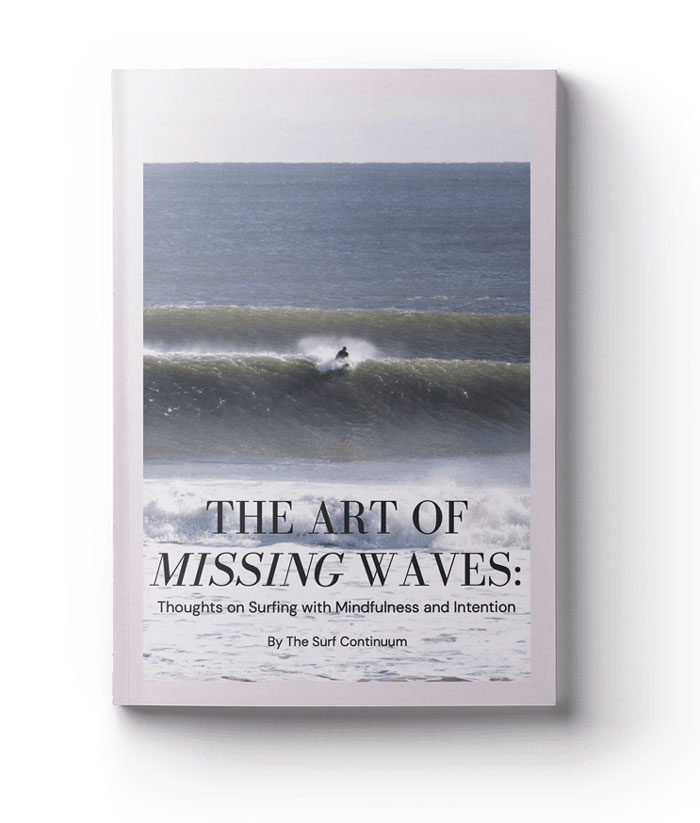
When you’re learning to catch a wave, you’re developing an understanding of positioning and timing all achieved through fundamental skills and an understanding of waves.
Every attempt provides more information whether it results in a catch or a miss.
Sometimes they’re positioned too far back on their board. Sometimes they’re too far outside. Other times they’re paddling for a wave from the shoulder when they should be closer to the peak.
Learning to recognize and correct these mistakes is what makes someone a better surfer.
When instructors push their students into waves, they may catch the wave, but the opportunity to learn is missed. In our eyes as well as most accomplished surfer’s opinions, that’s completely backwards.
The student experiences the reward without developing the skills required to reproduce it. The result is a person dependant on an instructor in order to continue riding waves.
That’s why we encourage students to embrace the difficult parts of surfing from the beginning when you still have the beginners mindset and the patience to make the mistakes beginners should be making on their way to success.
Why More Surf Lessons Don’t Always Mean Faster Progress
There’s a point at which taking more lessons doesn’t equate to greater returns.
Compare learning to surf with someone learning to play the guitar.
Progress isn’t determined so much by how often you meet with your teacher as it is by the amount of practice you dedicate to reinforcing what you learned in your last lesson.
Learning to surf works the same way.
As a coach, there are only so many things that need explaining to a student at a particular stage of their development.
Eventually, the student understands what needs attention. The deciding factor becomes whether they spend enough time practicing it.
A productive coaching session identifies weaknesses, provides useful corrections, and establishes a clear direction for future self practice.
Then the student needs opportunities to apply those lessons independently without the pressure of their coach watching.
How to Progress Faster Between Surf Lessons
If you want to accelerate your progress, what you do independently matters enormously.
Here are four things we encourage students to prioritize.
Practice the Skills Your Coach Identifies
Don’t leave a lesson and immediately return to doing whatever feels most satisfying.
If your coach identifies a weakness in your paddling or board control, dedicate time to improving that specific skill.
Purposeful practice is more valuable than simply spending hours in the water without a clear objective.
Spend Time in Easy Conditions
Not every session needs to involve riding waves.
For beginners, some of the most productive practice can happen in flat water.
This allows you to concentrate on specific movements without constantly reacting to approaching waves.
Choose safe, appropriate environments and don’t confuse small waves or flat water with an absence of ocean hazards.
Work on Mobility and Flexibility
Surfing places unusual demands on the body.
Simply lying on your stomach while extending your neck and upper body to look forward can be uncomfortable for someone who isn’t accustomed to that position.
Limited mobility can make otherwise simple surfing movements considerably more difficult.
We encourage students to supplement their surfing with activities that develop:
- Core strength
- Hip mobility
- Lower-back mobility and strength
- Comfortable spinal extension
- General flexibility and body awareness
Stretching, yoga, and appropriate strengthening exercises can all complement time spent surfing.
Stay Open to Changing What You Think You Know
This is especially important for surfers who have been trying to improve independently.
Sometimes the thing holding you back is a technique you’ve been practicing incorrectly for years.
Some of the biggest breakthroughs we’ve witnessed have come when students stop concentrating on standing up and begin working on something more fundamental, such as rail engagement or basic board control.
Remember the karate kid? All that sanding the floor and painting the fence didn’t feel like learning karate in the moment, but little did he know his sensei was cultivating a skill set in him he didn’t see developing.
Progress isn’t always about adding another advanced maneuver.
Sometimes it’s about finally understanding a basic skill you’ve been overlooking.
How Do You Know If Your Surf Coaching Is Working?
Don’t judge the quality of a coaching program by how many waves you ride during a lesson.
Judge it by what happens when your coach isn’t there.
Ask yourself:
- Am I becoming more comfortable and proficient handling my surfboard?
- Can redirect my board and transition into good paddling position efficiently?
- Am I developing a better understanding of where to position myself for waves?
- Do I know why I missed a wave?
- Am I making intentional decisions about which waves are mine to catch?
- Am I keeping my head up and eye-line long?
- Am I engaging my rail upon take-off?
- Do I know what I should practice during my next free surf?
- Am I avoiding crowds, near collisions, and negative attention of better surfers?
- Am I becoming less dependent on my instructor?
If the answers are increasingly yes, you’re making meaningful progress…even if you’re not yet standing up on every wave.
The Ultimate Goal of a Good Surf Coach
The objective of surf coaching should be to develop an independent surfer.
Someone who understands their equipment, reads the ocean, positions themselves appropriately, and catches waves through their own ability.
Someone who can continue improving even when their coach isn’t present.
Surfing is a lifelong pursuit, and even highly experienced surfers have opportunities to refine their fundamentals.
But meaningful progress can begin during your very first lesson, and with consistent practice and the right instruction, independent surfing in suitable conditions can become a realistic possibility within a few months.
The real question isn’t simply how quickly a coach can get you standing on a wave.
It’s how quickly that coach can teach you to surf without them.
Ready to Take Your Surfing Further?
Becoming a better surfer starts with stronger fundamentals.
Join The Surf Continuum for free and access instructional videos and courses designed to develop your fundamentals, improve your understanding of the ocean, and help you become a more independent surfer.
No payment required to get started.